VIRTUAL REALITY AND AUGMENTED REALITY IN MEDICAL TRAINING AND REHABILITATION
DOI:
https://doi.org/10.71465/jhmri65Keywords:
virtual reality, augmented reality, medical education, surgical simulation, rehabilitation, stroke recoveryAbstract
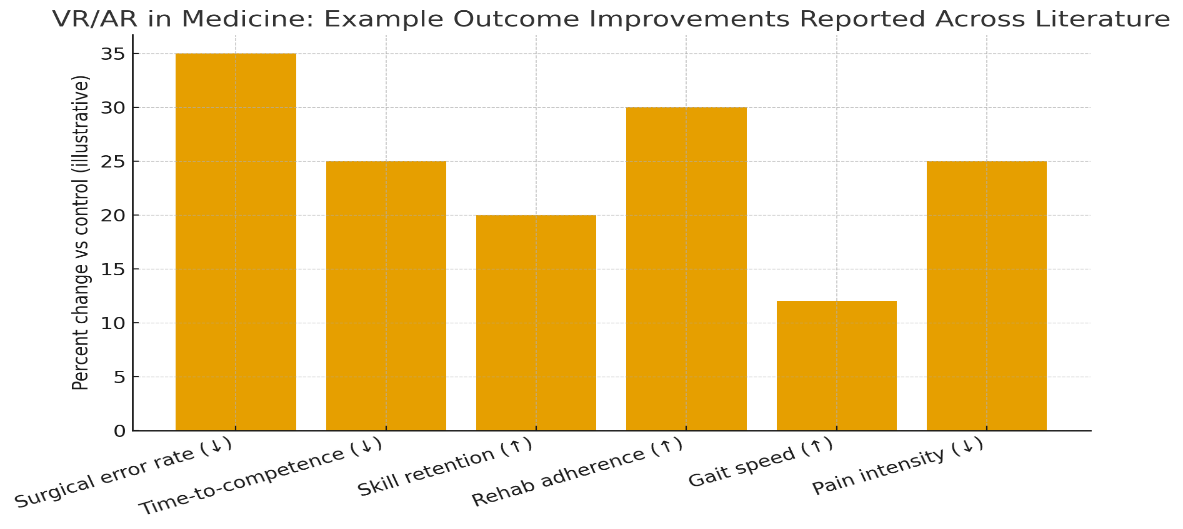
Virtual Reality (VR) and Augmented Reality (AR) are reshaping medical training and rehabilitation by providing immersive, repeatable, and data‐rich environments for skill acquisition and patient recovery. In education, VR/AR simulators improve psychomotor skills, reduce error rates, and accelerate time-to-competence, while AR overlays anatomical or procedural guidance onto real-world tasks. In rehabilitation, task-specific, gamified VR enhances adherence, motor relearning, and cognitive engagement; AR supports contextual feedback for gait/balance and activities of daily living. This article synthesizes evidence on effectiveness, safety, human factors, and implementation, with a focus on low- and middle-income country (LMIC) considerations. We outline design principles (fidelity, haptics, feedback, and adaptivity), evaluation methods, regulatory/ethical issues, and a pragmatic roadmap for hospitals and rehab centers.
Downloads
Published
Issue
Section
License
Copyright (c) 2023 Dr. Ayesha Khan, Dr. Hassan Raza, Prof. Laura M. Johnson, Dr. Kenji Tanaka (Author)

This work is licensed under a Creative Commons Attribution-NonCommercial-NoDerivatives 4.0 International License.
All articles published in the Journal of Health, Medical Research and Innovations are distributed under an open access license. Authors retain copyright and grant the journal the right of first publication. The published content can be freely accessed, shared, and reused for non-commercial purposes, provided proper citation is maintained and the original work is not altered.