3D BIOPRINTING OF HUMAN ORGANS: CURRENT PROGRESS AND FUTURE PROSPECTS
DOI:
https://doi.org/10.71465/jhmri55Keywords:
3D bioprinting, bioinks, vascularization, organ fabrication, decellularized ECM, GelMAAbstract
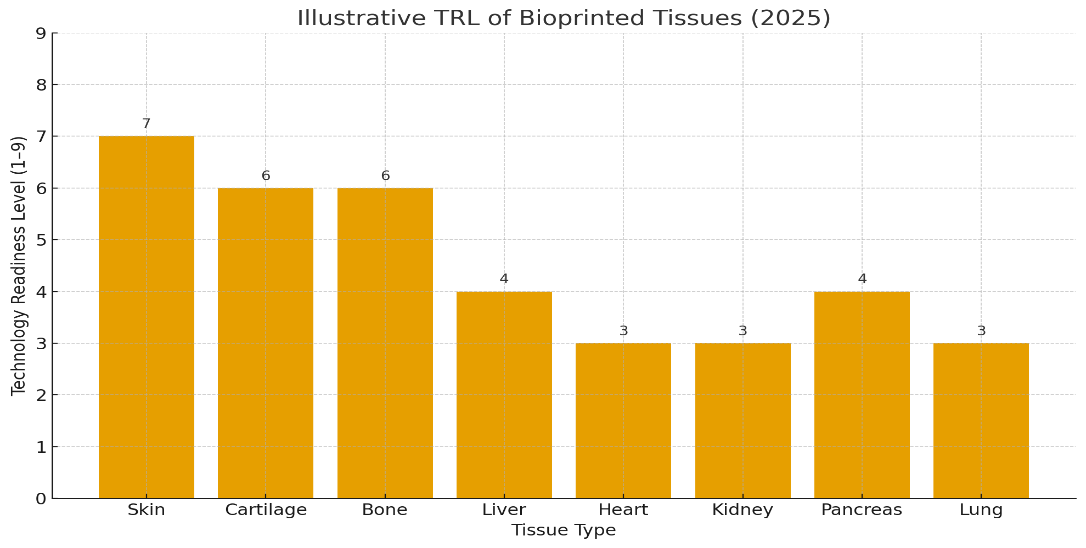
Three-dimensional (3D) bioprinting merges additive manufacturing with cell biology to fabricate living tissues with spatially controlled architectures. Over the past decade, extrusion, droplet-based, and light-based bioprinting modalities have advanced from proof-of-concept constructs to clinically oriented, prevascularized tissues. Concomitantly, bioink chemistry—spanning gelatin methacryloyl (GelMA), decellularized extracellular matrix (dECM), collagen/fibrin, alginate, and synthetic PEG derivatives—has matured to support print fidelity, cell viability, and functional maturation. Yet translation to whole-organ replacement remains constrained by inadequate multiscale vascularization and lymphatic drainage, limited innervation, immune compatibility, manufacturing metrology, and regulatory pathways. Here we synthesize the state of the art in tissue prototypes (skin, cartilage, bone, liver, cardiac, renal), highlight enabling technologies (sacrificial/vessel printing, embedded/FRESH printing, perfusion bioreactors, digital twins), and outline a roadmap for quality-by-design (QbD) manufacturing and clinical evaluation. We conclude with near-term prospects for skin and osteochondral grafts, mid-term goals for hepatic/kidney functional units, and long-term strategies toward architected organ systems.
References
Ahmad, N. R. (2026). AI-enabled public governance in developing states: Service delivery gains, accountability risks, and a practical risk-based regulatory model. Lex Localis - Journal of Local Self-Government, 24(S1), 99–117. https://doi.org/10.52152/wja5db40
Published
Issue
Section
License
Copyright (c) 2023 Ayesha Khan, Syed Hassan Jafri, Emma Rodriguez, Kenji Nakamura, (Author)

This work is licensed under a Creative Commons Attribution-NonCommercial-NoDerivatives 4.0 International License.
All articles published in the Journal of Health, Medical Research and Innovations are distributed under an open access license. Authors retain copyright and grant the journal the right of first publication. The published content can be freely accessed, shared, and reused for non-commercial purposes, provided proper citation is maintained and the original work is not altered.