PHARMACOGENOMICS AND PERSONALIZED DRUG THERAPY: TOWARD SAFER PRESCRIPTIONS
DOI:
https://doi.org/10.71465/jhmri71Keywords:
pharmacogenomics, personalized medicine, adverse drug reactions, clinical decision support, CYP450, HLAAbstract
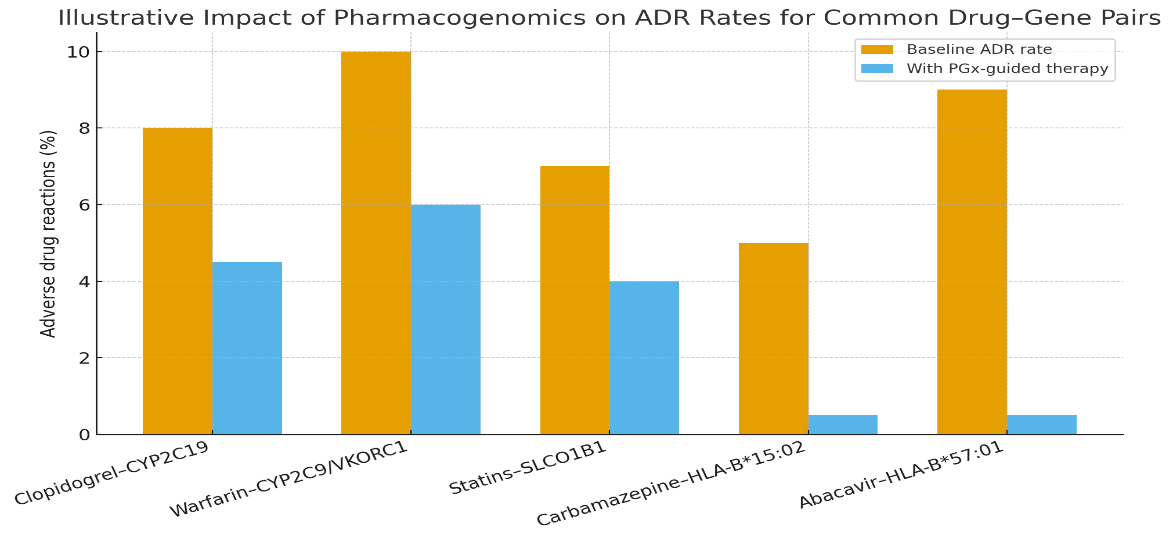
Pharmacogenomics (PGx) examines how inherited genetic variation influences drug disposition, efficacy, and toxicity. Across cardiology, oncology, infectious diseases, and psychiatry, variation in pharmacokinetic genes (e.g., CYP2D6, CYP2C19, CYP2C9, SLCO1B1) and pharmacodynamic or hypersensitivity loci (e.g., HLA-B*57:01, HLA-B*15:02, DPYD) contributes to avoidable adverse drug reactions (ADRs) and suboptimal outcomes. Implementation science now demonstrates that pre-emptive or point-of-care genotyping integrated with clinical decision support can reduce ADRs, shorten time-to-therapeutic response, and improve cost-effectiveness when deployed at scale. This article synthesizes core concepts, evidence for clinical validity and utility, and operational models for integrating PGx into prescribing workflows, with attention to equity, data governance, and contexts with constrained resources. We outline a pragmatic roadmap—test selection, EHR integration, structured reporting, education, and measurement of outcomes—culminating in future directions such as multi-omic risk stratification and learning health systems. Pharmacogenomics is transitioning from promise to practice; the remaining challenges are organizational rather than conceptual, and the opportunity is safer, more effective, and more equitable prescribing.
Downloads
Published
Issue
Section
License
Copyright (c) 2024 Dr. Sara Naveed, Dr. Muhammad Bilal Khan, Prof. Emma L. Johnson, Dr. Kenji Tanaka (Author)

This work is licensed under a Creative Commons Attribution-NonCommercial-NoDerivatives 4.0 International License.
All articles published in the Journal of Health, Medical Research and Innovations are distributed under an open access license. Authors retain copyright and grant the journal the right of first publication. The published content can be freely accessed, shared, and reused for non-commercial purposes, provided proper citation is maintained and the original work is not altered.