ROBOTICS IN MODERN SURGERY: ENHANCING PRECISION AND REDUCING RISK
DOI:
https://doi.org/10.71465/jhmri64Keywords:
robotic-assisted surgery, surgical precision, minimally invasive surgery, patient outcomes, learning curve, safety and riskAbstract
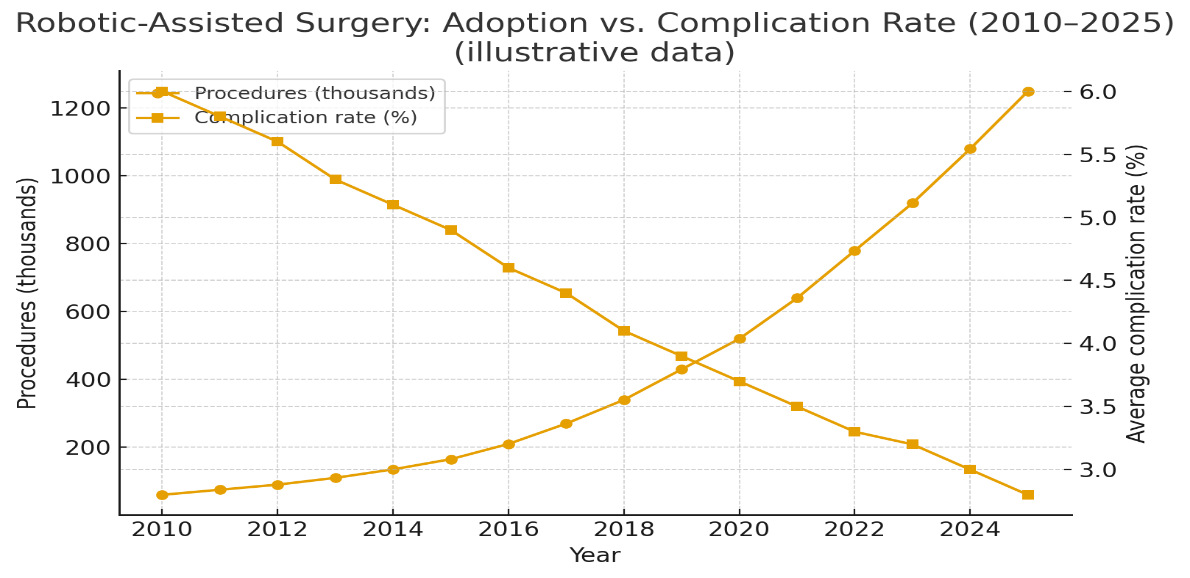
Robotic-assisted surgery (RAS) augments minimally invasive techniques with articulated instruments, tremor filtration, 3-D magnified visualization, and surgeon-controlled camera systems. Across urology, gynecology, general, thoracic, and colorectal specialties, RAS can reduce blood loss, shorten length of stay, and improve ergonomics; however, benefits vary by procedure, surgeon experience, and institutional workflow. Safety profiles depend on rigorous training, credentialing, and human-factors engineering to mitigate device- and user-related hazards. Economic value hinges on utilization rates, case mix, and perioperative efficiencies that offset capital and maintenance costs. Emerging capabilities—including AI-assisted perception, automation of subtasks, tele-mentoring, and AR overlays—promise further gains in precision and consistency while raising new regulatory and ethical questions. This article synthesizes current evidence on effectiveness, risk, and implementation and proposes a roadmap for safe, equitable scaling in both high- and low-resource health systems.
Downloads
Published
Issue
Section
License
Copyright (c) 2023 Dr. Ayesha Khan, Engr. Muhammad Bilal, Dr. Laura M. Chen, Prof. David R. Patel (Author)

This work is licensed under a Creative Commons Attribution-NonCommercial-NoDerivatives 4.0 International License.
All articles published in the Journal of Health, Medical Research and Innovations are distributed under an open access license. Authors retain copyright and grant the journal the right of first publication. The published content can be freely accessed, shared, and reused for non-commercial purposes, provided proper citation is maintained and the original work is not altered.