MACHINE LEARNING MODELS FOR PREDICTING PATIENT OUTCOMES IN CRITICAL CARE
DOI:
https://doi.org/10.71465/jhmri57Keywords:
ICU mortality prediction, machine learning, electronic health records, temporal modeling, AUROC, calibrationAbstract
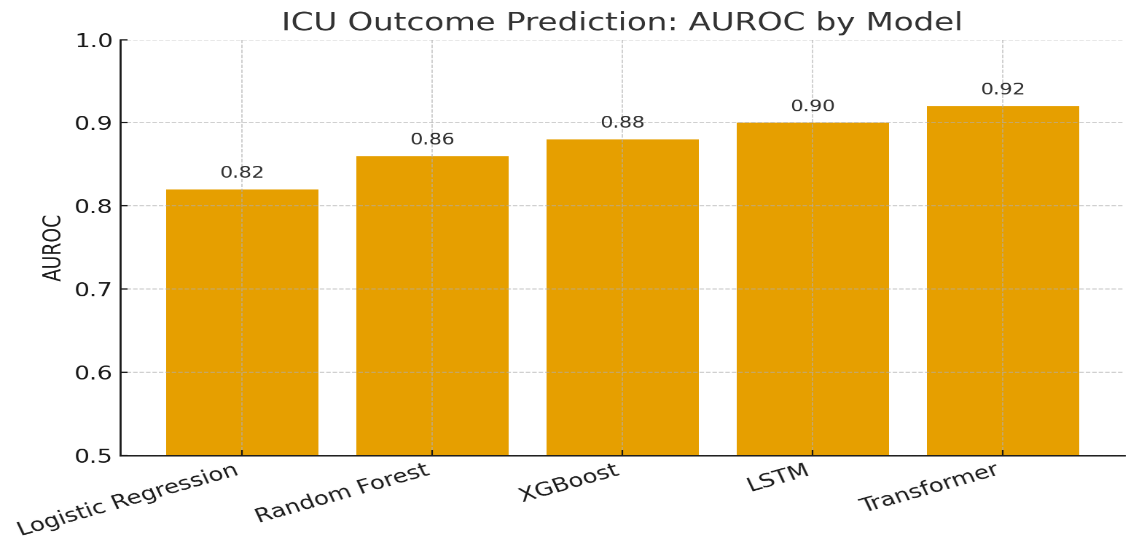
Predicting adverse outcomes in intensive care units (ICUs)—including in-hospital mortality, prolonged length of stay, and unplanned readmission—can inform timely interventions and resource allocation. This article reviews and synthesizes state-of-the-art machine learning (ML) methods for outcome prediction using electronic health records (EHR), physiologic time series, and laboratory data. We outline robust cohort construction from publicly available critical-care databases, compare feature engineering strategies (static vs. time-varying, handcrafted vs. learned), and detail modeling approaches from regularized generalized linear models to tree ensembles, recurrent neural networks, and transformers. We emphasize rigorous evaluation beyond discrimination (AUROC/PR-AUC) to include calibration, decision-curve analysis, and prospective transportability. Practical guidance is provided for interpretability (feature attribution, counterfactuals), fairness auditing across demographic subgroups, and MLOps for clinical deployment (drift detection, human-in-the-loop oversight). We conclude with a staged roadmap for validation—from internal cross-validation to silent shadow testing and pragmatic trials—highlighting regulatory, ethical, and implementation considerations in low- and middle-income countries (LMICs).
References
Ahmad, N. R. (2026). AI-enabled public governance in developing states: Service delivery gains, accountability risks, and a practical risk-based regulatory model. Lex Localis - Journal of Local Self-Government, 24(S1), 99–117. https://doi.org/10.52152/wja5db40
Downloads
Published
Issue
Section
License
Copyright (c) 2023 Dr. Ayesha Khan, Dr. Muhammad Asad, Dr. Emily Chen, Dr. Luca Bianchi (Author)

This work is licensed under a Creative Commons Attribution-NonCommercial-NoDerivatives 4.0 International License.
All articles published in the Journal of Health, Medical Research and Innovations are distributed under an open access license. Authors retain copyright and grant the journal the right of first publication. The published content can be freely accessed, shared, and reused for non-commercial purposes, provided proper citation is maintained and the original work is not altered.