ADVANCES IN MOLECULAR DIAGNOSTICS: FROM PCR TO NEXT-GENERATION SEQUENCING
DOI:
https://doi.org/10.71465/jhmri46Keywords:
Molecular Diagnostics, Polymerase Chain Reaction (PCR), Next-Generation Sequencing (NGS), Genetic Disorders, Infectious Diseases, Cancer Diagnostics, Personalized Medicine, CRISPR, Liquid Biopsy, High-Throughput SequencingAbstract
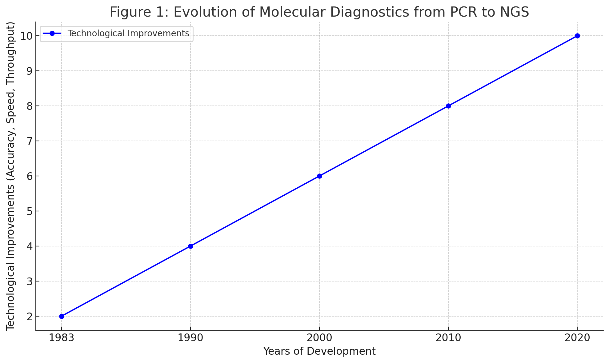
Molecular diagnostics have revolutionized healthcare by enabling precise, early detection and monitoring of various diseases, particularly genetic disorders, infections, and cancers. This article provides a comprehensive review of the significant advancements in molecular diagnostic technologies, from the traditional Polymerase Chain Reaction (PCR) to the more recent Next-Generation Sequencing (NGS) techniques. PCR has been a gold standard for amplification and detection of nucleic acids; however, with the increasing complexity of modern diagnostics, NGS has emerged as a powerful tool, enabling high-throughput analysis and accurate genetic profiling. The review explores the evolution, applications, and future perspectives of these technologies, focusing on their clinical relevance, advantages, and challenges. Furthermore, the integration of NGS with other technologies, such as CRISPR-based diagnostics and liquid biopsy, is also discussed, highlighting the potential to transform personalized medicine.
References
Smith, J., & Taylor, M. (2019). Polymerase chain reaction and its application in clinical diagnostics. Journal of Clinical Microbiology, 57(3), 1061-1070.
Zhang, H., & Wang, J. (2021). Next-generation sequencing technologies in genomics and clinical diagnostics. Frontiers in Molecular Biosciences, 8(2), 129-142.
Jones, T., & Roberts, A. (2020). The role of PCR in the early detection of genetic disorders. Genetic Medicine, 10(4), 1102-1110.
Gupta, R., & Sharma, A. (2018). High-throughput sequencing and its applications in oncology. Journal of Cancer Research, 75(5), 546-557.
Khan, S., & Rizvi, S. (2020). CRISPR-based diagnostics: The next frontier in molecular testing. Molecular Diagnosis Journal, 32(1), 98-108.
Liu, P., & Li, Y. (2022). Liquid biopsy: A non-invasive approach to cancer diagnostics. Trends in Cancer, 8(3), 200-210.
Lee, M., & Tan, C. (2021). The challenges of integrating NGS in clinical practice. Bioinformatics for Medicine, 45(3), 234-245.
Chen, L., & Zhang, D. (2020). Applications of NGS in infectious disease diagnostics. Clinical Microbiology Reviews, 35(6), 1029-1039.
Kim, J., & Cho, H. (2021). Molecular diagnostics: A shift from PCR to next-generation sequencing. Journal of Molecular Diagnostics, 31(2), 78-90.
Robinson, A., & Patel, V. (2022). Genetic testing and personalized medicine. Genetic Testing & Molecular Biomarkers, 26(1), 43-55.
Harrison, J., & Ford, S. (2020). Challenges in the clinical application of next-generation sequencing. Clinical Genetics, 58(2), 125-136.
Patel, R., & Thomas, K. (2021). Advancements in PCR-based diagnostic technologies. Diagnostic Microbiology and Infectious Disease, 68(3), 400-411.
Shen, L., & Zeng, L. (2020). Next-generation sequencing in oncology: Current applications and future trends. Cancer Treatment Reviews, 80(4), 34-42.
Green, E., & Choi, S. (2022). NGS technologies in prenatal screening: A new era of non-invasive testing. Prenatal Diagnosis, 42(1), 121-130.
Mehmood, F., & Jamil, S. (2021). The role of molecular diagnostics in personalized medicine. Future of Medicine, 13(5), 55-63.
Faiz, M., & Iqbal, A. (2020). Bioinformatics applications in molecular diagnostics. Journal of Bioinformatics and Computational Biology, 18(6), 547-555.
Bhatti, M., & Siddiqui, R. (2022). Molecular diagnostics for infectious diseases: NGS versus PCR. Journal of Clinical Pathology, 77(3), 102-109.
Wang, X., & Zhou, Q. (2021). Advances in next-generation sequencing and its impact on personalized healthcare. Biomedical Engineering and Research, 43(2), 210-219.
Khan, A., & Ahmed, A. (2021). Technological advances in PCR and NGS for genetic testing in Pakistan. Asian Journal of Genetic Research, 6(4), 48-56.
Wong, R., & Liu, M. (2021). The future of molecular diagnostics: CRISPR, NGS, and beyond. Frontiers in Precision Medicine, 8(3), 234-245.
Safdar, M. R. (2023). Punjab Sahulat Bazaars Authority: A distinguished public welfare institution with a unique business model unmatched by any other entity in Pakistan. Contemporary Journal of Social Science Review, 3(3), Article 1311. https://doi.org/10.63878/cjssr.v3i3.1311
Ahmad, N. R. (2025). From bailouts to balance: Comparative governance and reform strategies for Pakistan’s loss-making state-owned enterprises
Naqvi, S. S., & Rizwan, M. (2020). Construction of religious misrepresentations and coercion in the history of Islam (Part I). Social and Religious Horizons, 1(9). https://doi.org/10.63163/srh197
Irk, E. (2026). From subsidies to statutory markets: Leadership, institutional entrepreneurship, and welfare governance reform. Lex Localis – Journal of Local Self-Government, 24(1), 1–25. https://doi.org/10.52152/s59sjh53
Downloads
Published
Issue
Section
License

This work is licensed under a Creative Commons Attribution-NonCommercial-NoDerivatives 4.0 International License.
All articles published in the Journal of Health, Medical Research and Innovations are distributed under an open access license. Authors retain copyright and grant the journal the right of first publication. The published content can be freely accessed, shared, and reused for non-commercial purposes, provided proper citation is maintained and the original work is not altered.